
For this blog I want to demonstrate how widely artistic interpretations can vary even if they are depicting the same subject during the same time period. Specifically this blog will cover artwork surrounding the American Revolution that was crafted during the neoclassical time period. I chose three distinct portraits of the American Revolutionary War hero and first president of the United States of America, George Washington.
George Washington (The Anthenaeum Portrait)
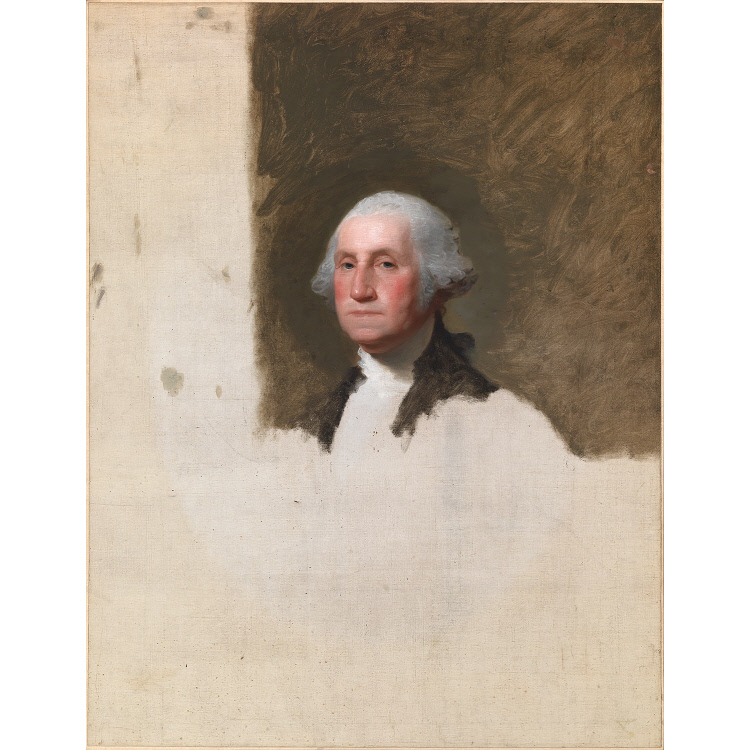
The chances are high that most of you reading this are in possession of a copy of this portrait of George Washington, commonly referred to as The Anthenaeum Portrait. Painted by Gilbert Stuart in Philadelphia in 1796, this unfinished portrait served as the basis for Washington’s portrait on the one-dollar bill, making it one of the most widely recognizable and widely circulated depictions of the president.
Art Elements
It is impossible to comment on this piece as a whole (for obvious reasons), but even still, it is an interesting painting to look at. There are no harsh lines or colors in this painting, portraying a feeling that is softer in general, evoking a sense of calm and control. The area behind Washington’s head has a different texture than the surrounding area, drawing emphasis to his face; perhaps Stuart’s intent was to create a similar effect in the final product. Washington is dressed in plain black, further placing the emphasis of the portrait directly on him.
Stuart was reportedly a strong supporter of physiognomy, a now defunct pseudoscience, which correlated a person’s physical features to their personality and character as a whole. As I pointed out earlier, Washington seems to have a calm and collected aura around him (desirable in a leader). Perhaps this was intentional on Stuart’s part, especially since it has been reported that this portrait was not necessarily the best physical portrayal of Washington. Not to say that it was fictitious in anyway, just that something was slightly different, perhaps the intentional manipulation of Stuart. In an article about The Anthenaeum, Gabrielle Hick states, “perhaps the popularity of Stuart’s portraits can be attributed to the extent to which his contemporaries believed he had truly suggested the personality of the president.”

Why leave it unfinished?
Simple answer: money.
Who knows if that was Stuart’s pure intention at the start, but it definitely ended up working out that way. Born in Rhode Island, Stuart eventually made his way to London and Dublin, racking up significant debt along the way. In fact, it was this debt that eventually drove him back to America and Washington. Stuart actually wrote in a letter to a friend that, “I expect to make a fortune by Washington alone. I calculate upon making plurality of his portraits… I will repay my English and Irish creditors.”
Stuart eventually did just that. After leaving the above portrait unfinished (likely to keep as reference), Stuart went on to create over 100 more portraits of Washington. In her article, Hick writes that Stuart capitalized, “on a market hungry for images of the country’s beloved leader.” This falls right in line with the characteristics of the neoclassical period, a time in which patriotism, heroism, and morality (traits that Stuart strove to capture in his portrait) were all valued.
George Washington (Bust)
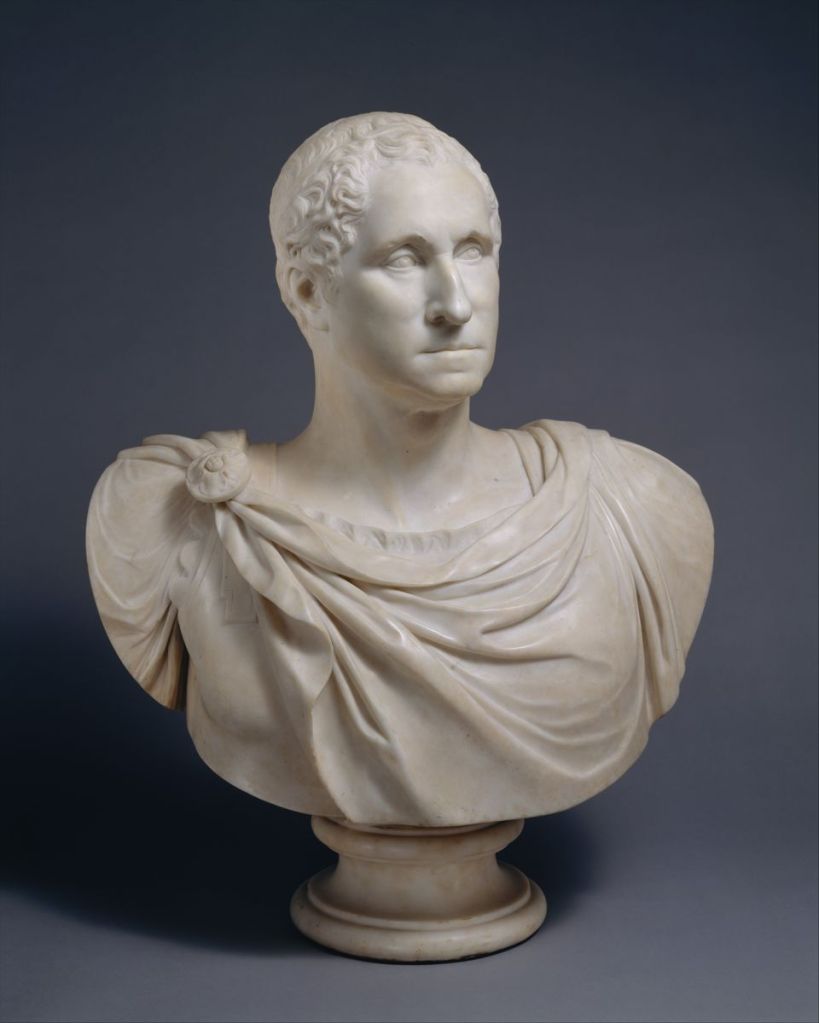
When I first saw this bust, my mind didn’t automatically recognize who it was. Maybe it’s due to the lack of long curly locks (which I consider to be quintessential of the time), but I suspect that I was confused by the Roman garb that the man is donning. This bust of George Washington, sculpted by Italian artist Guiseppe Ceracchi in Philadelphia in 1795, is not how we usually imagine Washington looking, but it does demonstrate strong connections with artistic influences of the time period.
Art Elements
Form is the most important element in this bust. Ceracchi creates different textures throughout the sculpture – smooth skin, folded clothes, and as well as wavy hair. This bust is not the most precise I have seen in terms of the amount of detail put into the clothes and hair, but the ideas come across nonetheless. Washington has a composed look on his face, gazing off into the distance, conveying a sense of strength.
As I said earlier, this is not how we are typically accustomed to seeing Washington depicted. For me this includes not only what Washington is wearing, but what his face looks like as well. However, many of Washington’s contemporaries believed this bust to be the most life-like representation of the president. It just happens that we are so used to seeing other portraits of Washington (like The Anthaneaum on the one dollar bill) that when we do see a truer version of Washington, we don’t consider it to be as accurate.
American (and Roman) Hero
When Ceracchi crafted this bust he was hoping to obtain a commission from the United States Congress to build a monument for the American Revolutionary War. Ceracchi never ended up obtaining that commission, but he did sculpt numerous busts of influential Americans along the way.
Ceracchi’s choice to portray Washington in Roman attire really encapsulates the trends of the neoclassical period. Heroism, patriotism, and morality, along with Roman influences were all main traits of the neoclassical period. All of those aspects are present in this bust. Ceracchi, although not American himself, played into the ideals of the American people at the time, portraying Washington, a hero amongst the people, as a powerful Roman soldier.
George Washington, Trumbull

This portrait of George Washington, painted by John Trumbull in London in 1780 shows a triumphant looking Washington. Many portraits of similar appearance exist, all slightly different, painted by Trumbull or different artists, but essentially depicting the same thing: Washington’s grandeur.
Art Elements
The different tones of this painting, ranging from light to dark draw emphasis to Washington. The sky looks turbulent and dark, maybe symbolizing the strife that had happened in the colonies during the war. However, the sky surrounding Washington himself is lighter in tone, almost serving as a halo of sorts. This not only further draws our attention to Washington, but also gives him an almost transcendent appearance. Furthermore, Washington’s servant on the right is shrouded in darker tones and colors, pushing him to the back almost like an afterthought, echoing the sentiment surrounding servants at the time.
Washington is posed in what I like to informally call the “Captain Morgan” pose. Although nowadays it is often associated with rum and all of the debaucuhery surrounding that, the pose itself does convey a sense of power. Through the variations in tone, and triumphant pose, Trumbull strove to capture the essence of Washington’s military excellence.
Depicting Greatness
Trumbull served as an aide-de-camp for Washington during the Revolutionary War, allowing him to become familiar with the then general. Upon Trumbull’s return to London, he painted this portrait of Washington from memory. It was one of the first representations of Washington available in Europe, where it was subsequently copied by many throughout the area. If you do a simple Google image search for “George Washington standing portrait” or something close, you will be able to see similar portraits painted by numerous artists. They are not exactly the same, but have the same general principle – Washington posed triumphantly, usually dressed in military attire.
In Conclusion
It is truly amazing how artists during the same time period can draw inspiration from the same subject matter, yet create pieces so vastly different. The piece, in my opinion, that captures the essence of the neoclassical period the most is the bust of Washington sculpted by Ceracchi. Between the Roman clothing and the subject being portrayed, Ceracchi’s bust of Washington truly embodies the influences of the time. Of the three pieces above, my favorite is the unfinished Anthenaeum Portrait, I suspect because it is the portrait of Washington I am most accustomed to seeing. I would love to own numerous copies of it (read: lots of money!).
Citations
Eubanks, W. Ralph. “A Portrait On Paper: Chernow’s ‘Washington, A Life.'” NPR (Oct 5, 2010) https://www.npr.org/templates/story/story.php?storyId=130161943
“George Washington (The Athenaeum Portrait)” National Portrait Gallery. (n.d) https://npg.si.edu/object/npg_NPG.80.115
“George Washington” The Met. (2019) https://www.metmuseum.org/art/collection/search/192901
“George Washington” The Met (2019). https://www.metmuseum.org/toah/works-of-art/24.109.88/
Hick, Gabrielle. “How an Unfinished Portrait of Washington Ended Up on the Dollar Bill” Artsy. (Jun 7, 2017) https://www.artsy.net/article/artsy-editorial-unfinished-portrait-washington-ended-dollar-bill
 Malia's Explorations in Art 200X
Wow, very thorough blog. Its fascinating how there is so much variation within a single period, but it reminds me of something I read about Napoleon. Napoleon refused to sit down to be painted, claimed it was his character and not his likeness that mattered.
I recently blogged about a different John Trumbull’s George Washington portrait and it looked very different in the face. Like the Anthenaeum Portrait, Thumbull’s General George Washington at Trenton was used for many etches and by the USPO for several stamps.
LikeLike
How interesting, I have seen The Anthenaeum Portrait who knows how many times, and I never connected it to the dollar bill till you Enlighted me with this information. The painting’s colors, I feel it adds a comforting appeal to the former president of the United States. I believe the texture of the background highlight the softness of his skin. I agree with you that both color and lines are what makes this painting such a masterpiece (even if it was never finished.)It is interesting in every one of the pieces of art George Washington looks slightly different compared to the first painting. In the Bust his face structure is similar but if the artist tried to add his wig or if that is his natural hair it does not match the first painting. In the Trumbull his face structure doesn’t match any of the other pieces of art.
This was an amazing post, by the way, very enticing.
LikeLike
I like the mentioning the business model that Stuart had. Find the biggest celebrity in America and churn out his likeness. It sounded like Ceracchi had the same ambitions. Portraying Washington in a way that resembles a Roman Emperor might have had a negative connotation associated with it, especially in a time of political uncertainty. The colonials just fought off one Emperor, now there are statues of another Emperor all over the capital. I am glad that artists began to shed the idea of immortalizing leader in classical clothing.
LikeLike
This was a clever idea – great spin to put on the assignment. Personally, I’m grateful for the cue that the bust was considered the most accurate. Your in-depth analysis of the artists’ motives was a pleasure to read, and your pieces showed both deviation and unity, and the early mention of Gilbert Stuart’s use of physiognomy was very interesting. Personally, I think that art has two simultaneous combative purposes: to depict reality, and to exaggerate reality to emphasize the communication. Seeing these multiple portraits really exemplified how those two attempts can swerve between artists.
LikeLike
Picking Washington for your relationship with the leadership themes was very clever! I think he’s a good staple of patriotism for that time period so it goes hand in hand with our thematic focus. I actually didn’t know that his rendition on the dollar bill wasn’t technically as accurate as it could have been, I always figured that was the most accurate portrait of him there was, so this was really interesting!
LikeLike
What a great way to execute this assignment. I never would have thought to pick one influential figure from that time and find many different visual representations of them. I find the bust the most interesting. I know that wigs were common during that time but it’s rare to see people without.
LikeLike
I just commented on another blog about the Revolutionary War about the United States declaring Independence after the war was over, which is now Independence Day on July 4th of every year. The appealing part to me is the paintings and history of George Washington, the first president of the United States, and whose portrait in on the $1 bill of the United States currency.
LikeLike