
Introduction
When I think of famous statues of the biblical figure David, my mind instantly goes to the towering marble figure sculpted by Michelangelo. There exist, however, numerous depictions of David, including a bronze statue created by Donato di Niccolò Betto Bardi, who is more commonly referred to simply as Donatello. The David, made by Donatello sometime between 1420-1460 (likely 1440) in Florence, Italy, may not hold the same notoriety in popular culture as Michelangelo’s David, or be as tall (standing at just 158 cm compared to 5.17 m), but it does have a story to tell about the Italian Renaissance, as well as life in Florence during that time period.

Art Elements
A major element of this piece is obviously the form of the sculpture. Donatello’s David was the first freestanding nude male sculpture since antiquity. Donatello had previously sculpted another fully clothed depiction of David out of marble some years prior. One of the major differences between Donatello’s two statues, apart from the lack of clothes, is the relaxed stance of the bronze David. This posture, called contrapposto, is characterized by the subject having nearly all of their weight in one leg, leaving the other leg slightly bent at the knee. The weight shift also causes a slight tilt in the hips, shoulders, and head, further giving an air of life to the statue.
In addition to the curved, natural lines conveying life and movement, there are some straight and strong lines as well. David is holding the sword he presumably used to cut off Goliath’s head, depicting strength. Strength is conveyed here not only because of the subject matter (a sword) but because of the strong lines as well.
Homoerotic Themes
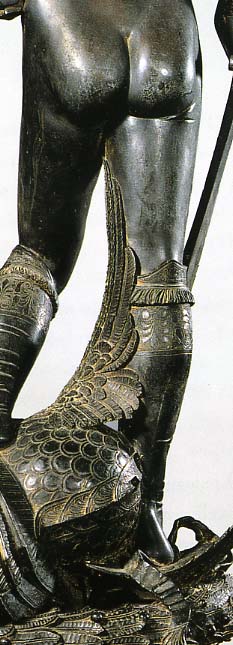
Some argue that the David has strong homoerotic themes. One of the major components of this argument is the feather in Goliath’s helmet. Said feather extends up off of the helmet, gently touching David’s inner thigh, evoking a sense of eroticism (homosexual or not). Secondly, there was a significant culture of homosexuality in Florence during this time. In this statue, the boy is nude with the exception of the hat he is wearing. It was described that during this time a “game” of sorts existed in the streets of Florence for men who desired to partake in male-male sex. During this “game,” it is said that older men would steal the hats of younger boys and coerce them into having sex before returning the hat. In this way, the hat that David is wearing alludes to the practices in Florence during that time. On top of all of this, Donatello himself was homosexual, further adding speculation to themes of homoeroticism in his famous work.
Medici Family Connection
It is widely thought, however not confirmed, that Cosimo de’ Medici commissioned this famous work. It has been documented that the David was on display as the centerpiece in the courtyard of the Palazzo Medici during the wedding of Lorenzo de’ Mecidi and Clarise Orsini in 1469. Regardless of whether or not Cosimo did the commissioning, the Medici family did eventually come into possession of the sculpture.
The sculpture can also be seen to represent the Medici Family’s political power at the time. The David was placed on a column which read, “The victor is the defender of the fatherland. God crushes the wrath of an enormous foe. Behold! A boy overcame a great tyrant. Triumph, o citizens!” (Williams, 1989). Possible connotations of “triumph” related to the Medicis are ongoing conflicts with Milan, or Cosimo’s return from exile in 1434.

Humanist Connection
As pointed out in the “Art Elements” section, the David is standing in contrapposto, a posture that was popular for artists to employ during Greek and Roman times as well. As we know, humanism was partly characterized by drawing on influence from ancient times, with this contrapposto posture being a potential link between the two times.
Additionally, humanism also focused on physical beauty. The David is arguably a beautiful statue. The figure is quite androgynous looking, potentially making it appealing to either the male or female eye.
Lastly, humanism placed power into the human spirit, and what is more powerful than the idea of triumph? The story of David and Goliath, told in 1 Samuel 17, tells of a young Israelite who beats the giant Goliath with nothing more than a slingshot and stones. This story of triumph and conquest by the underdog hit especially close to home for the Florentine people who had historically themselves been the underdogs.
Final Thoughts
In all honesty, the David by Donatello is not one of my favorite sculptures. I can appreciate the themes that are present, and the backstory of victory associated with it, however, the David looks very young to me, which coupled with him being depicted nude, leaves me feeling uneasy and uncomfortable. I personally prefer the appearance of Michelangelo’s David. However, if there ever comes a time in my life when I am able to travel to Italy and have the opportunity to see only one of the Davids, I would choose to go to Museo Nazionale del Bargello in Florence and see Donatello’s bronze David. I say this because I have heard that there are so many people that want to see Michelangelo’s David that it is an absolute madhouse (like around the Mona Lisa at The Louvre, which I have been to and was overwhelmed by the crowd).
Citations
Ames-Lewis, Francis. “Donatello’s Bronze David and the Palazzo Medici Courtyard.” Renaissance Studies, vol. 3, no. 3, 1989, pp. 235–251. JSTOR, www.jstor.org/stable/24409868.
“Analysis of the Art of Renaissance Italy: Donatello’s David” Italianrenaissance.org (2015) http://www.italianrenaissance.org/donatellos-david/
“Contrapposto” Encyclopaedia Brittanica. (n.d) https://www.britannica.com/art/contrapposto
“Donatello’s David” (n.d) http://employees.oneonta.edu/farberas/arth/arth213/donatello_david.html
“Humanism in Donatello’s David” The Force of Art. (2014) https://ctullarinfluencingart.wordpress.com/2014/09/26/humanism-in-donatellos-david/
 Malia's Explorations in Art 200X
Hi Malia,
While I find this statue beautiful, in modern times, this statue would not depict the epitome of manliness. Even though I have seen pictures of Donatello’s “David”, every time I see it, my first thought is of a woman wearing a bonnet with ringlets flowing to (her) shoulders. David’s slender shoulders, narrow waist, and hairless body definitely give him the look of an adolescent boy. Which leads me to wonder, was hair removed in order to look younger and prepubescent in order to appeal to men? I highly prefer Michelangelo’s David to Donatello’s – it’s more masculine and manly to me.
The intentional placement of the feather on David’s inner thigh is very bold. It draws in one’s eyes to naturally follow it upwards to the tip as it seemingly points to his buttocks.
As I clicked on your link for Contrapposto, I was quite intrigued at how profound of a “sculptural scheme” it was. I find the pose more attributed to a mother holding her child on her hip. It was a natural pose for me for many years!
Thank you for the interesting blog about David and contrapposto. This was intriguing to me, and I found some more information on the topic:
https://emptyeasel.com/2007/12/18/what-is-contrapposto-in-art-heres-an-explanation-of-classical-contrapposto/
LikeLike
If you’re interested in David’s hair there’s a good explaination here: http://employees.oneonta.edu/farberas/arth/arth213/donatello_david.html
LikeLike
Hi Malia,
This sculpture is a pretty amazing piece of art. While looking though tons of pieces from the renaissance era i payed more attention to the paintings than the sculptures. While this is a very nice sculpture with more meaning behind it than most, i found some of the paintings in the Italian renaissance era more intriguing. That’s not to say this piece is less detailed and appealing to the eye! I also think you linked this sculpture to humanism very well. Humanism is all about physical beauty, philosophical ideals, Greek history, and spiritual influence. The posture like you mentioned is a nice link between them, as well as the physical beauty, as the sculpture is nude. It was great learning this history behind this!
LikeLike
Good evening Malia,
You and I both chose a statue as our piece of art and they are both Davids. I chose Michelangelos’ where you chose Donatellos’. In my blog I mentioned other artists including Donatello, and one of the things that I found most intresting and the reason I chose Michelanglo’s David instead of any other was that Michelangelo depicted David before the battle, while other artists depict David as the victor he was. Donatello did a great job, in Davids stance, the hand on his hip, the foot on Goliath’s head. He promotes confidence, everything about this statue says I won, I am the victor. Donatello used details that show these same things, the hair, the detail in Goliath’s head, and the way he is holding the sword.
LikeLike
My roommate happened to walk in just as I was scrolled to the section on homoerotic themes with the detail that included the statue’s buttocks. Of course, I had to explain what I was looking at, so we actually had a lengthy and quite nice discussion on the physique of David in this statue. We both agreed with you that the portrayal seems to have a large number of feminine and masculine traits on the body, and we especially thought so regarding his hat and hair (although this one is specifically Dependant on the culture of the viewer, of course), the pose, the way the muscles are defined, and the somewhat ambiguous portrayal of the bust.
While I also appreciate the story behind the work, I must say that I find Michelangelo’s David to be my preferred portrayal of David. The story of David and Goliath involves a great deal of masculinity, and I find that this portrayal is too dissimilar to what I picture while reading the story.
LikeLike
Wow! How interesting! First, I had no idea about the homosexual tendencies of this era, that is new information to me. Also what an interesting anecdote about the hat game, also new information. I agree with your opinion of the overall subject matter making you mildly uncomfortable though, it puts me off too. Although, different times I suppose…
That’s also really interesting about the Medici family’s connection to this piece, it’s crazy to think that this was likely present at such an influential place and time. With the humanist connection, I was unaware of the importance of the contrapposto posture as you described it or the importance of it but now that you pointed it out, I can totally think of other sculptures or portrayals in the humanist style that share that posture. Thank you!
Elizabeth
LikeLike
This is a very interesting piece of work! You pointed out aspects that I never would have thought of considering before. As you this is not my favorite sculpture of David. The bold masculinity that post statue of David portray isn’t there.
As you said this one has a more, almost, boyish feel. I never would have thought about considering a homosexual tendency with this piece of work. However, The more I look at the, the more I can see it in the pose, the feather from goliath’s helmet, etc..
LikeLike